Agentic Game Development
August 28, 2026
I will be participating in the summer game jam in Regensburg in a few days, so I did some studying in game development (I haven't done much of it for the last two years). I implemented
- A procedural level generator using the wave-function-collapse algorithm
- A multiplayer version of my top-down shooter Project Noir; I published a demo under the name Strike-Noir. Eventually, I wanted to implement a bomb-defuse gamemode à la Counter Strike, but for now there is only deathmatch.
- An evolutionary game, where you play a zookeeper that breeds interesting creatures, which is now published under the name Chimera Tycoon
For the latter, I wanted to find out the current state of agentic game development (GameDev).
The defining limitation of agentic AI in GameDev is the visual complexity of game engines. The user has to click and drag different components around, which is challenging for an LLM. The solution is an MCP server that translates actions in a game engine (for example: add a collision shape, create a script, etc.) into a text-based interface that an AI can access. In the Godot engine, Godot-AI is such a tool. I tested this with Claude Cowork (Opus 5.0, Medium Thinking Effort).
The Game
I was inspired by this YouTube video on procedural animation. The original implementation is in Processing, a Java-based graphics program. My original plan to test Cowork's abilities was "port this to Godot", but I already found a port on GitHub. Now, the agent's task was to:
- Implement a creature randomizer
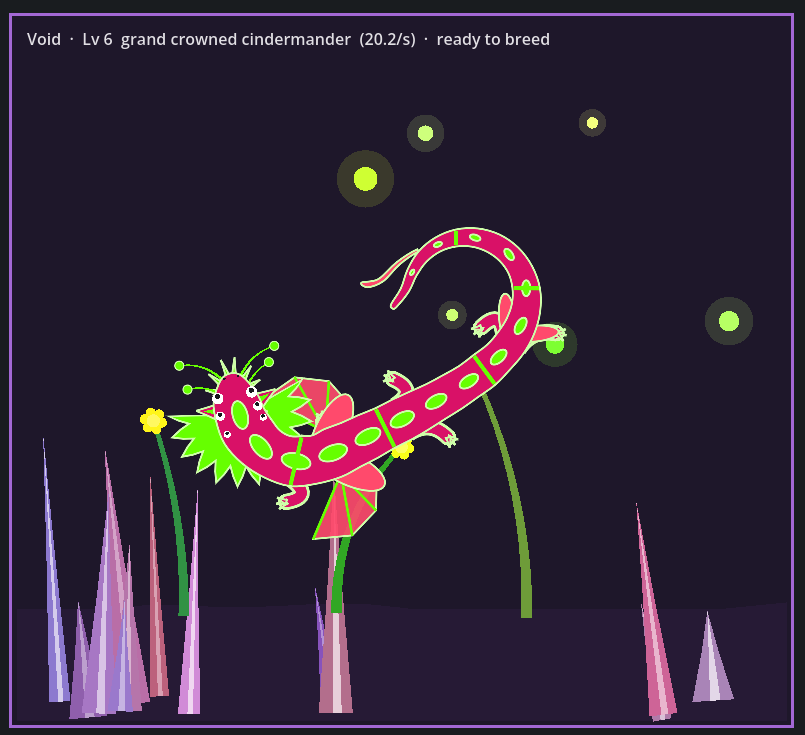
- Implement a Zoo / Evolutionary game, where the player (zookeeper) can buy animal enclosure slots and animal eggs. The eggs produce creatures, and the player can combine 2 creatures to gain a more interesting creature (there are levels 1-10). More interesting animals yield more visitors, and hence more revenue.
Developer Experience
The model worked accurately; I uploaded a browser-playable demo here. Using the MCP Server, it created this scene in the Godot Editor:
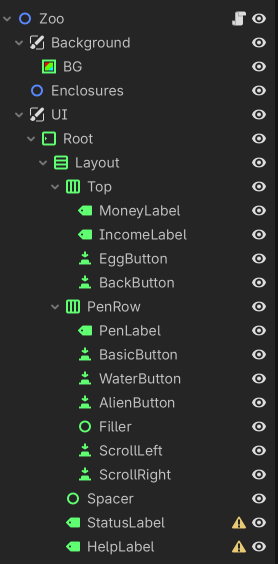
Although this is impressive, I don't think this is a real speed-up over a traditional agent just writing scripts per instructions. The code quality is fine, especially for a game-dev project. The coding agent prefers to configure things at the script level; I would have configured them in the editor, for example here:
001func _ready() -> void:002 var loaded := load_game()003 if not loaded:004 _start_new_zoo()005 _layout_enclosures()006007 egg_button.pressed.connect(_on_egg_pressed)008 erase_button.pressed.connect(_on_erase_pressed)009 #back_button.pressed.connect(_on_back_pressed)010 basic_button.pressed.connect(_on_buy_pen.bind(CreatureTraits.Habitat.BASIC))
registering the events at the source-code level (egg_button.pressed.connect(_on_egg_pressed)) seems weird to me.
Prompts Used
Over the following prompts (sic!), Cowork used 100% of the basic plan's daily usage.
001In the current Godot Game "Procedural Animation", different animals are implemented:002(and animated procedurally) snake, lizard and fish.003004I want you to create an abstract animal that can have a creative combination005of animal-features already present.006Also add horns and similar animal-features.007008Create a randomizer that creates animals with fun characteristics.009There should be a level parameter (1-10) where 10 creates larger, fancyer animals
This worked perfectly, although this was more of a proof of concept for me.
001This is the starting point for a demo of a game. Do this in a different scene.002003The game is a Zoo: The player is a zoo-keeper that can buy slots / enclosures004for animals and Eggs (that produce level one creatures)005006Then, the player can combine 2 creatures into one of higher level,007where the features inherit.008009Creatures of higher level yield more income for the zoo.
This prompt created a proof of concept for the game. Some fixes were in order:
001Works. Some suggestions0020031. The pens are too small for the animals.004Let the player scroll to see at most 2 pens side by side, that occupy most of the screen.0052. Add (procedurally animated) plants (and other deco) to the pens.006There should be 3 levels of pens, each costing more.007 1. Basic008 2. Water009 3. Alien / Fancy0103. One should only breed 2 animals of the same level.011Then the resulting animal is one or 2 levels above the starting point.012Lock some features into the pens envrionment013 1. color should depend on the envrionment014 2. some features should be locked (fins to water etc)
Here, the MCP server became unresponsive. Claude handled this well and recovered after I restarted the game engine.
001The enclosures are now bigger, but the creatures also,002so the problem "enclosure too small" still holds.003I like the layout, just make the creatures smaller.
001Now a deeper bug: If a creature reaches its goal-point, its body repositions,002i. e. not just the first joint. This is visually unnapealing.
001More Tasks0020031. The Creature should have a period of 30s to 6min (depending on level),004unitl it can be combined. Let the Creature grow in size during this time.0052. Add persistence, and a button to erase the save
001Good. Add background music. I attached 3 tracks, that should be played,002depending on what allotment was added last.003Dont switch the abrubtly, though.004005In case you want to use python to convert tracks (if required), use pyenv.
I attached background tracks from opengameart.com, which were in different formats. Claude Cowork did in fact use Python to even out the volume and convert them to .ogg.
001Increase the price of eggs over time